
The website serves as a starting point: it helps you understand the areas of work, the general process, and the role of lawyers. Client stories highlight the issues that arise during the process. The official decision remains with the agency of the selected country, so the overview should be read as a basis for preparation, not as a forecast of the outcome.
What does open information show?
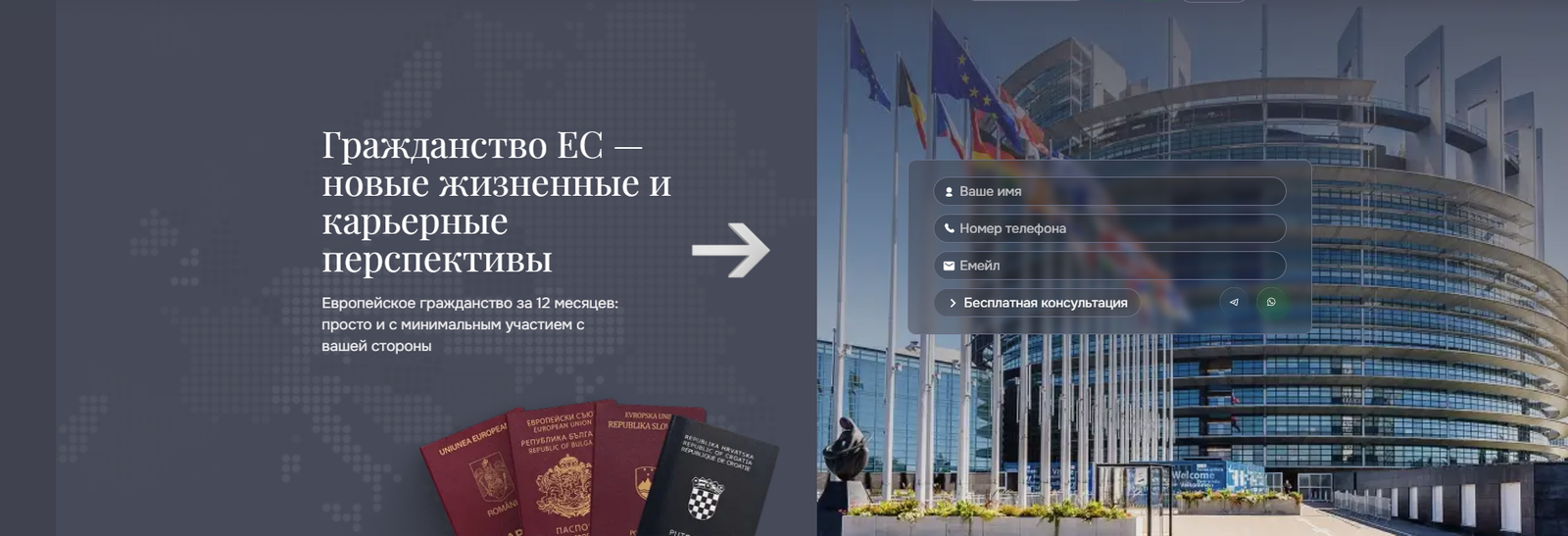
The website displays information about the company’s lawyers’ support for clients considering citizenship in European Union countries. Publicly available materials include Romania, Bulgaria, Croatia, Slovenia, and other EU destinations. This list is useful for a basic understanding of the migration process, but it doesn’t necessarily mean that the same procedures and procedures apply in all countries.
Civitas-Europe’s service description highlights several recurring elements: consultation, situation analysis, dossier preparation, paperwork, and client information. This organizational assistance can be crucial for those who don’t want to navigate the process in a chaotic manner and ultimately want to obtain a passport without any negative consequences.
The website also lists the opportunities available to migrants upon obtaining EU citizenship: residency in EU countries, work without a separate permit, travel, access to healthcare, social support, and business ownership. These points explain the interest in citizenship but do not confirm the eligibility of a particular applicant for approval.
How to understand if a direction is suitable
The initial assessment begins with the question of eligibility. Repatriation, origin, family lineage, and relatives’ documents often come up in discussions. Therefore, choosing a country shouldn’t be based solely on personal preference. It’s important to understand what information can be verified and what documents the applicant or their family already possesses.
Reviews of Civitas-Europe show that people are asking questions about Slovenia and Croatia, family applications, travel, remote document submission, and contact with specialists. This information is useful as a list of topics for consultation. However, other people’s experiences are not the rule: similar family histories may differ in terms of documents, the age of the child, place of residence, or access to archives.
Before talking to a specialist, it is useful to prepare the following questions:
- what basis can be considered in a specific situation;
- what family documents have already been collected;
- where there are gaps in information;
- will an archival search be required;
- Is it possible to include a spouse or child?
- what actions cannot be performed remotely;
- what will be specified in the contract.
This list shifts the conversation from general interest to a practical level. It doesn’t replace the verification process, but it helps quickly understand what data needs to be collected. For Civitas-Europe, such questions are also important because they reveal the true scope of the future dossier.
Documents, archives and family cases
Documents in this case are not a formality, but the foundation of the file. Sources mention a passport to initiate the process. Further requirements depend on the direction and reason. If the procedure involves family lineage, birth, marriage, and death certificates may be required, as well as documents linking several generations.
Some client stories show that not all the information is readily available. In such cases, specialists launch an archive search. This isn’t necessary for every applicant, but it can be an important step if it’s impossible to assemble a coherent document chain without old records. Therefore, one review of quick preparation and another example of a lengthy document restoration may describe different, but equally possible, situations.
Family-based applications are occasionally mentioned in publicly available materials. Spouses and minor children are mentioned, included in the parent’s application package. In such cases, it’s important to check in advance what documents each participant needs, how the workload changes, and whether this affects the price.
Translations, apostilles, and powers of attorney are part of the application process. They help ensure the documents are in the correct format, but do not constitute the basis for citizenship. Their necessity depends on the country, program, and document content. Civitas-Europe’s role in this area should be assessed by how clearly the paperwork is explained.
Agreement, cost and communication format
The cost in open sources doesn’t appear to be uniform for everyone. The country, number of applicants, family application, availability of original documents, archival searches, translations, apostilles, and the scope of specialist involvement are all included in the calculation for each individual case. Some reviews mention family conditions and a partnership program, but without exact amounts. Therefore, it’s more accurate to consider the price as an individual agreement condition.
A contract is necessary to establish the scope of services, payment procedures, the parties’ responsibilities, and actions to be taken in the event of a change in circumstances. One review describes a situation where, after preparations had begun, the client decided to include their spouse in the process. The scope of work increased, so the list of services and terms of cooperation had to be revised. This specific example demonstrates why it’s best to review the cooperation documents and the amendment procedure before active preparation.
The format of communication with Civitas-Europe is described in open discussions as mixed. The authors mention telephone consultations, sending scans, mailing documents, and meetings at specific stages. This arrangement may be convenient for those located in another country. However, remote communication does not replace in-person participation, if required by the procedure.
How to Read Customer Reviews Without Leaning
Reviews are useful when they provide context: country, stage, documents, contract, problem, and communication method. A short review can convey an impression, but rarely explains why the process went quickly or took longer. Materials without details should not be used to draw conclusions about timeframes, prices, or the likelihood of success.
When reading such publications, it is worth keeping several guidelines in mind:
- one particular experience is not a rule;
- Client assessment does not replace the terms of the selected program;
- a description of the stages and documents is more useful than general praise;
- a successful example does not confirm the same result for another applicant;
- the timeframes depend on the country, family, archives and files;
Citizenship, temporary residence permit, permanent residence permit and naturalization are not one and the same procedure.
This approach helps separate facts from emotions. Praising a lawyer’s work speaks volumes about how they perceive the service. Mentioning an archive, a contract, an apostille, a trip, or a family filing is more practical because it’s linked to a specific action. A single review can only be useful if it’s detailed, while general reviews require careful reading.
For evaluation, the content of reviews, rather than the quantity, is more important. If the text specifies the country, stage, and documents, it helps to more accurately formulate questions before signing the contract. The final conclusion should remain cautious: Civitas-Europe is involved in organizing the process, and the decision on the application is made by the competent authority of the selected country.